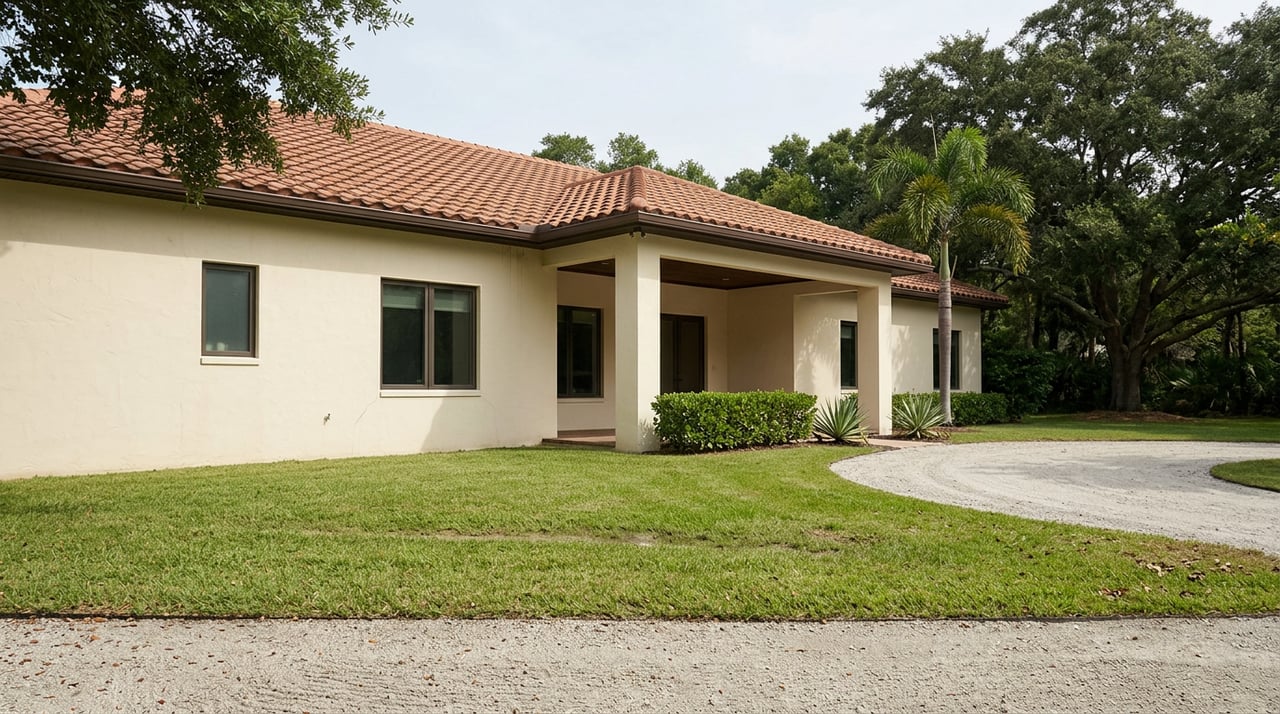
Two three-acre lots, both in The Acreage, both listed with the same line in the marketing copy: no HOA. A buyer comparing them on paper would assume the carrying costs are basically the same, maybe a few hundred dollars apart depending on lot size. What that buyer would not see, because it rarely makes it into a listing, is that one lot sits in an Indian Trail Improvement District unit whose per-acre bill just dropped by more than a hundred dollars, and the other sits in a unit whose bill went up. Same community. Same "no HOA" pitch. Different math, and the difference isn't random.
The fee that isn't one fee
Indian Trail Improvement District, known locally as ITID, is the special taxing entity that maintains roads, drainage and parks across roughly 27,000 acres of The Acreage and Loxahatchee. It gets no county, state or federal money for its roads. Everything comes from an annual per-acre assessment paid by property owners inside its boundaries, which is why real estate conversations out here treat it almost like an HOA dues line even though it legally isn't one.
Here's the part that gets lost in a quick search: ITID isn't one district charging one number. It's divided into 21 separate taxing units, and each unit's assessment is calculated on its own, based on what capital work is happening inside that unit's boundaries in a given fiscal year. Two lots can sit less than a mile apart and belong to different units with different bills, because the assessment follows the infrastructure spending, not a district-wide average.
That distinction is exactly what a buyer researching The Acreage needs to understand before comparing two listings on price alone.
Two consecutive years, opposite directions
The clearest evidence of how much this varies shows up when you line up two back-to-back budget cycles.
For fiscal year 2026, ITID's board of supervisors voted unanimously on July 7, 2026 to raise assessments for ten of the district's 21 units, taking the average bill from about $947 per acre to roughly $1,004 per acre, an increase of $57.59. Two units moved in unusual directions that same year: one jumped $199 per acre, another dropped $21.
Then, at a June 2, 2026 budget workshop looking ahead to fiscal year 2027, district staff presented numbers heading the opposite way for most owners. Units 1, 2, 4, 5, 10 and 12 were projected for decreases of more than $100 per acre, with Unit 10 alone in line for a $170.36 drop. Only six of the 21 units, numbers 6, 14, 20, MD2, M2L and 7M, were projected for increases, and the largest of those was $28.37 per acre in Unit 14. The smallest movement in the entire district was six cents per acre in unit 7M.
| ITID Unit | FY2026 (approved July 2026) | FY2027 (proposed at June 2026 workshop) |
|---|---|---|
| Unit 10 | Part of the ten-unit group, up $57.59/acre | Largest projected decrease: down $170.36/acre |
| Unit 14 | Part of the ten-unit group, up $57.59/acre | Largest projected increase: up $28.37/acre |
| Unit 20 (Santa Rosa Groves) | Roughly $328/acre after a cost-share for new equipment, up about $124/acre from 2025 | Listed among the small group still projected for an increase |
The board's final vote on the 2027 numbers was scheduled for August 19, 2026. Whatever the certified figure ends up being, the pattern the workshop revealed holds regardless: a unit's trajectory from one year to the next has almost nothing to do with the value of the home sitting on it and almost everything to do with which capital projects the district is funding inside that unit's lines.
Where the money actually goes
The swings above aren't noise. They trace back to specific, named projects.
ITID created an in-house Aggregate Department in August 2025, quarrying rock directly from its own M-1 and M-2 impoundment areas instead of buying it commercially. Executive Director Burgess Hanson told the board in May 2026 that the program had already supplied 38,000 tons of material the district would otherwise have had to purchase, part of an effort he described as a way to control costs as fuel and commodity prices stay unpredictable. Unit 20, home to Santa Rosa Groves, absorbed a specific cost-share for standing up that department, which is a direct reason its per-acre number ran higher than most of its neighbors in 2026.
Roads tell a similar story. In January 2026, ITID leadership named the M-1 Impoundment expansion, sometimes called the 640 acres project, as the district's top priority for the year, alongside a plan to rebuild a stretch of Orange Grove Boulevard from the substructure up between 110th Avenue North and Royal Palm Beach Boulevard. ITID President Elizabeth Accomando pointed to that stretch specifically, telling the board it made no sense to keep patching potholes there. Neither of those projects touches every unit equally, and neither shows up on a listing sheet.
As board member Betty Argue put it during a discussion about how tightly the board should track spending once a budget is approved, the process can feel less like careful oversight and more like watching things move on their own momentum. She described it as feeling like the district was running like a bus rambling down the street, a comment aimed at the board's own budgeting process rather than at any single project, but it captures something true for buyers too: the money moves, and it doesn't always move where you'd expect.
The road you can't see in the listing photos
There's a second layer to this that matters just as much as the dollar figure: whether the road in front of your lot is paved at all.
ITID maintains 458 miles of road across the district, and more than 250 of those miles are still dirt. Since the district gets no outside road funding, every mile of paving or resurfacing has to be justified and budgeted unit by unit. The district's R3 Road Paving Plan, approved by the board in 2019 after a public hearing and later bond-financed, was built specifically to identify which unpaved roads would be paved or resurfaced with millings, prioritizing routes that improve access to schools, parks, ITID facilities and fire-rescue stations. Not every road that residents wanted made the list. Mango Boulevard was considered during the original hearings but pushed to a later phase, while a different stretch, 89th Place North, was approved for full paving instead of the milling treatment other segments received.
That list changes slowly and it changes by petition, not by demand alone. A property owner on a still-unpaved road can formally request enhanced surface stabilization, but the district's own process requires a majority of the other owners with access to that road to agree before it moves forward. If your neighbors aren't interested, your road stays as it is.
For a buyer comparing two similar lots, this is the kind of detail that never shows up in a virtual tour taken on a dry afternoon. A rainy Tuesday commute looks very different on a road that made the R3 list than on one that didn't.
What this means before you write an offer
None of this makes The Acreage a harder place to buy. It makes it a place where the standard questions aren't enough. Before comparing two lots on price per acre, it's worth asking:
- Which of ITID's 21 units does this specific parcel sit in, and what has that unit's assessment done over the past two fiscal years?
- Is the road fronting the lot part of the R3 paving plan, already paved, or still on the district's unpaved list with no scheduled improvement?
- Has the unit taken on any recent cost-share obligations, like Unit 20's Aggregate Department assessment, that wouldn't show up in a general district average?
- What did the seller's most recent ITID notice actually list as the per-acre charge, not the district-wide figure quoted in a general search?
Our buyer's guide walks through the broader purchase process for western Palm Beach County, and if you're already looking at specific parcels, a quick pull of the current ITID unit assessment for that address takes minutes and tells you more than most of the marketing copy will.
Does every Acreage lot pay ITID the same rate?
No. Assessments are set per unit, and the 21 units have moved in different directions in consecutive recent budget years, sometimes by more than $150 per acre.
Will a road that isn't paved today ever get paved?
Only if it's added to a future phase of the R3 plan or if a majority of property owners with access to that road petition ITID directly for surface stabilization. Neither happens on a fixed schedule.
Does a paved road change what a lot is worth?
Road condition affects daily livability and long-term maintenance costs for the owner, which is part of what any buyer should weigh when comparing similarly priced lots in different units.
If you're comparing lots in The Acreage and want the specific unit assessment and road status pulled before you write an offer, On Call Realty can get you that answer directly, along with a straightforward read on what it means for your specific parcel. Schedule a free consultation and we'll walk through it together.
This article is general information, not legal, tax or financial advice. Consult a qualified professional about your situation.